Single-Stage Reloading: The Precision Path
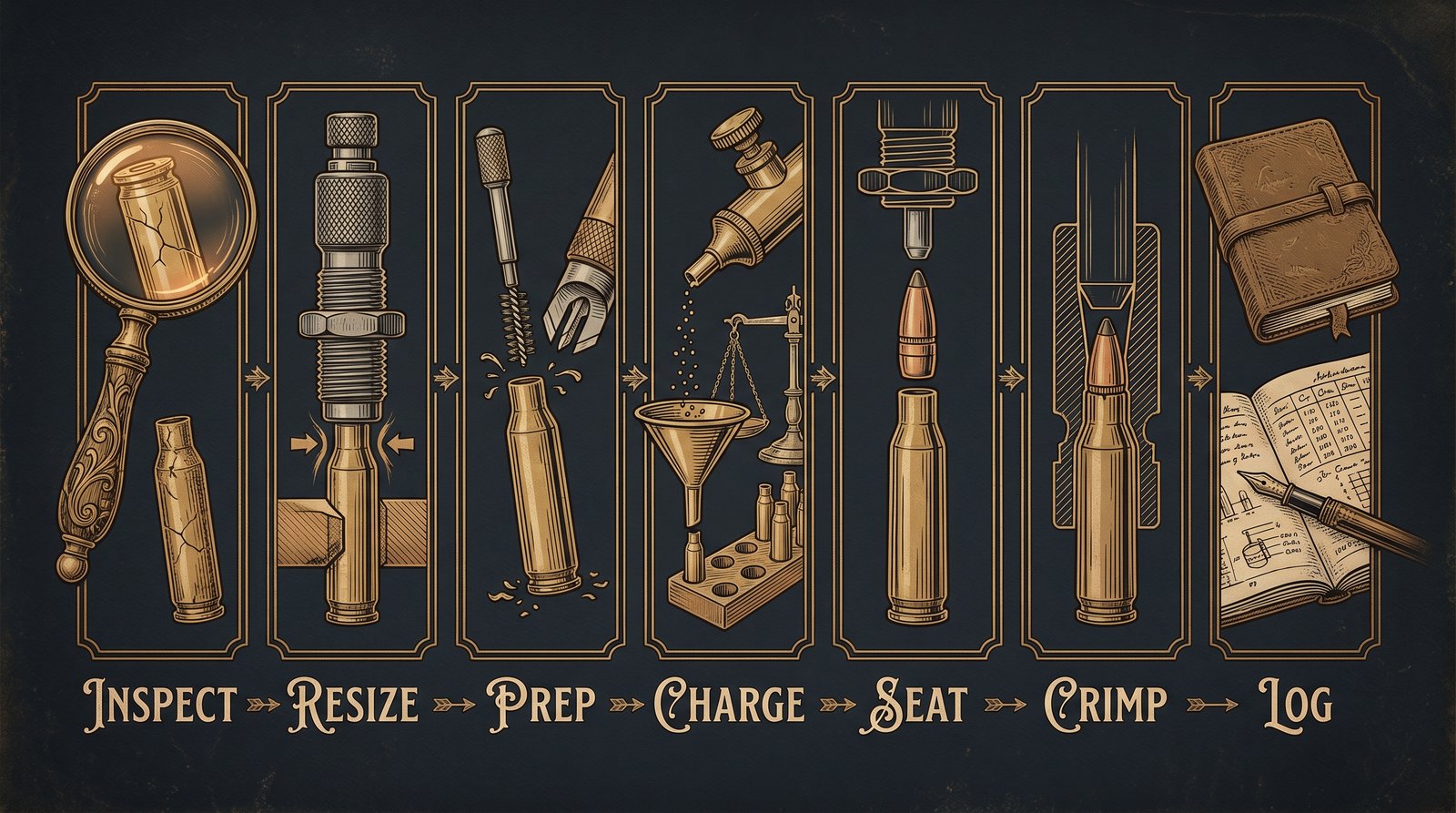
Single-stage presses do one thing per pull of the handle. You decap and resize a case, set it down, swap the die, prime, set it down, swap again, drop powder, seat the bullet. Every round passes through the press five times.
That sounds slow because it is. It is also why every match-grade rifle load you have ever read about was probably built on a single-stage press.
What "Single-stage" Actually Means
A single-stage press holds one die at a time. To run a full reloading cycle on a single round, you swap dies between operations. Most reloaders organize the bench around batches: deprime and resize a hundred cases, then prime a hundred cases, then charge a hundred cases, then seat a hundred bullets. The work is sequential by station, not by round.
The most common single-stage presses on used handloader benches:
- RCBS Rock Chucker Supreme. Cast iron, decades of parts support, the default first press.
- Forster Co-Ax. No shellholder, jaws self-center the case. Heavy, expensive, beloved by F-class shooters.
- Redding Boss / Big Boss. Compact O-frame. A shorter throw than the Rock Chucker, popular with handgun-cartridge reloaders too.
- Lee Classic Cast. Budget option. Ugly. Works.
If you are tracking a load by lot, by firing, by group size, the kind of load development that needs a chronograph and a target spotter, a single-stage press is the right tool. Each round gets your hands on it five times. That is five chances to spot a high primer, a creased neck, a powder bridge, a cracked case head.
The Case for Going Slow
Precision rifle loads, F-class loads, benchrest loads, the loads that win matches, are virtually always developed on single-stage presses. The reasons:
- Charge consistency. When you weigh every charge on a beam scale (or trickle to a digital scale), the round-to-round variation is below the resolution of the chrono. Volumetric powder measures, even good ones, throw ±0.1 to ±0.3 grain. For a 30-grain rifle charge, that is a real velocity spread.
- Concentricity. Some single-stage die setups (Forster Co-Ax, Redding Type S bushings) produce loaded rounds with measured runout under 0.001 in. That is hard to match on a progressive without a final concentricity check station.
- Inspection. Five hands-on touches per round means you see every case before, during, and after charging. The last touch, seating the bullet, is also the last chance to catch a charge weight that does not feel right.
- Workup discipline. A ladder test, 5 charges, 0.3 grain apart, three rounds each, is 15 rounds total. A progressive press is overkill. A single-stage press is exactly the right pace.
When Single-stage Is the Wrong Answer
Single-stage volume tops out around 100 to 150 rounds per hour for an experienced reloader, and that is with the bench set up cleanly and a single cartridge in the queue. If you are loading 500 rounds a week of 9mm for USPSA practice, a single-stage press will eat your weekend.
That is what progressives are for. See Progressive vs Single-Stage: Which Press Fits Your Volume for the breakeven analysis.
What to Track in BrassTracker
Even a single-stage workup benefits from a logbook. Per round (or per five-round group), the eight numbers worth recording:
- Bullet (manufacturer, model, weight)
- Powder (manufacturer, model, charge weight in grains)
- Primer (manufacturer, model)
- Brass (manufacturer, headstamp, lot if marked)
- OAL or CBTO (whichever you measured)
- Powder lot (different lots burn differently)
- Workup temperature (temperature drift is real)
- Pressure / sticky-bolt notes
BrassTracker stores all eight on every recipe, links the recipe to the firearm, counts firings on each brass lot, and rolls velocities up into ES/SD/avg per session. The same screen shows which load shot tightest by MOA per firearm, the answer to "which load do I bring to the match" without needing a spreadsheet.
Try BrassTracker
BrassTracker is $2.99 once, yours to keep. The base app handles every recipe, every firing, every group. Optional Pro upgrade adds the ballistics solver (drop chart, wind hold, MOA / mil holdovers), the web companion, PDF range cards, and advanced analytics for shooters who want them.