Brass Life by Cartridge: Typical Firings Before Retirement
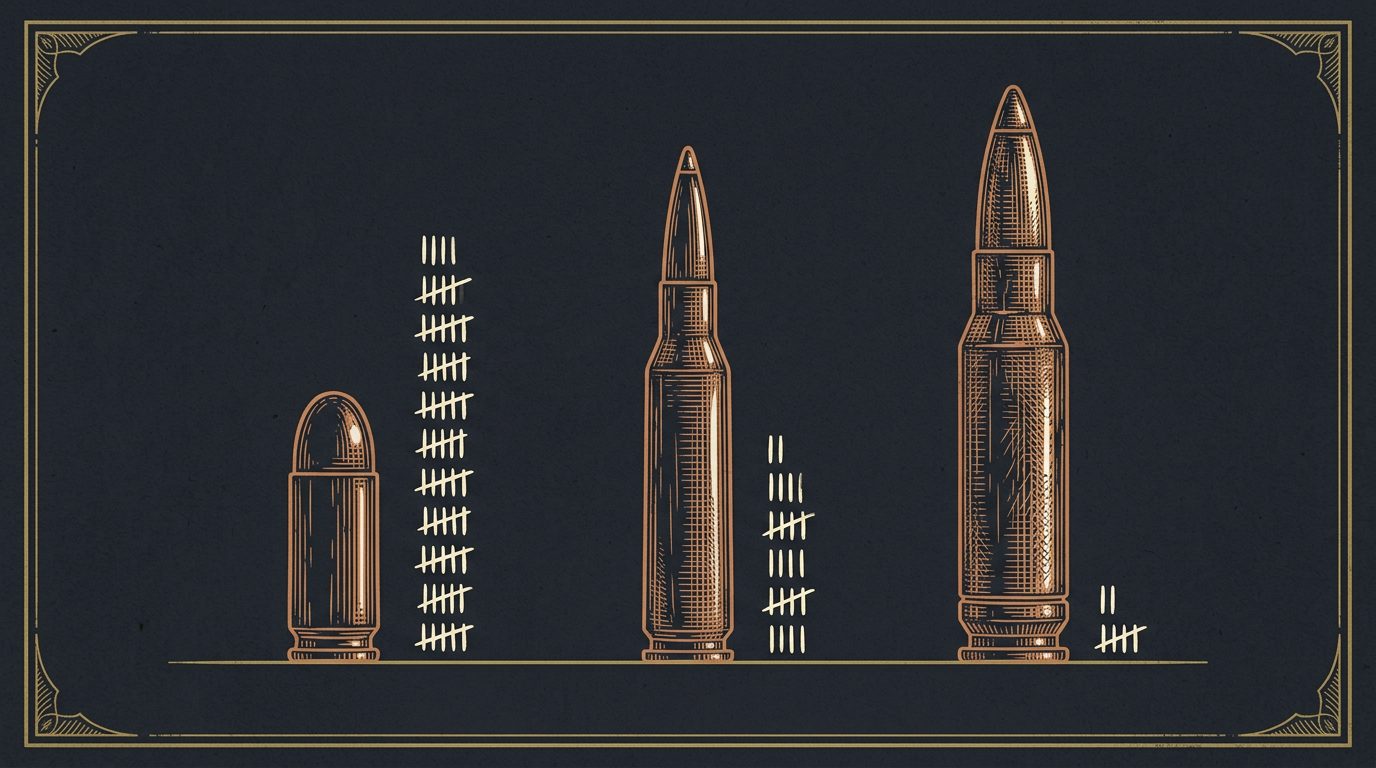
Brass life is the number of times a case can be fired and resized before something on it gives up. It is not a fixed number. It depends on the cartridge, the load pressure, the resizing method (full-length vs neck-only), the rifle's chamber, and whether the brass is annealed.
These ranges are what experienced reloaders typically see in practice. Your mileage will vary, sometimes wildly, but the order of magnitude is reliable.
Rifle Cartridges
| Cartridge | Typical firings | Notes |
|---|---|---|
| .223 Rem / 5.56 NATO | 3 to 6 (semi-auto), 6 to 10 (bolt) | Gas-gun extraction is hard on case heads. AR brass dies young. |
| .308 Win / 7.62 NATO | 5 to 8 (full-length sized) | Mid-pressure cartridge with a generous case head. Anneal at 4 firings to push to 10+. |
| 6.5 Creedmoor | 5 to 8 | Mid-pressure modern design. Lapua and Peterson brass routinely hit 8 to 10 with care. |
| 6mm Creedmoor | 4 to 6 | Higher pressure than 6.5 CM, smaller case head, harder on brass. |
| 6mm Dasher / BR / BRX | 8 to 12+ | Low body taper, tight chambers, gentle on brass. The benchrest brass-life ideal. |
| .30-06 | 4 to 6 | Classic large case. The case head is the failure point on tired brass. |
| 6.5 PRC | 4 to 6 | Higher pressure than 6.5 CM. Shorter brass life, especially with hot loads. |
| .300 Win Mag | 3 to 5 | Magnum pressure. Belt sizing is the typical kill mode. |
| .300 PRC / .338 Lapua | 3 to 5 | High pressure, large capacity. Brass is expensive; baby it. |
| 6.5x47 Lapua | 8 to 12 | Lapua brass, mild SAAMI pressure, very long service life. |
| .22 LR (rimfire) | 1 | Not reloadable. Listed only because someone always asks. |
Pistol Cartridges
| Cartridge | Typical firings | Notes |
|---|---|---|
| 9mm Luger | 8 to 15 | Mid-pressure. Failure mode: case-mouth splits, lost cases at the range. |
| .40 S&W | 5 to 8 | Higher pressure than 9mm. Glock-fired brass has the famous bulged-base "Glocked" issue. |
| .45 ACP | 10 to 20 | Low pressure. Cases routinely outlast the reloader's interest. |
| .357 Magnum | 10 to 20 | Revolver brass barely flexes. Long life. |
| .38 Special | 15 to 30 | Mild pressure, straight wall. The brass-life champion. |
| 10mm Auto | 4 to 7 | Higher pressure than .40 S&W. Hot 10mm loads kill brass faster. |
| .44 Magnum | 8 to 15 | High pressure for a revolver. Watch primer pockets. |
What Actually Kills Brass
Cases retire for one of three reasons. In rough order of how often each is the killer:
- Loose primer pockets. After enough firings, the primer pocket no longer holds a primer with the right interference. You will feel a primer seat with almost no resistance, that case is done. This is the dominant failure mode for high-pressure rifle cartridges (6.5 PRC, .300 PRC, .338 LM) and the killer for hot 10mm.
- Neck splits. Every time the case is fired and resized, the neck work-hardens. Eventually it cracks. Annealing every 3 to 4 firings prevents this. Without annealing, neck splits are typically the kill mode for unannealed .308, .223, and 6.5 CM brass.
- Case head separation. A horizontal crack near the case head, caused by repeated full-length resizing pushing the shoulder back too far. This is the dangerous failure mode and the reason every reloader should know how to feel for an incipient head separation with a bent paperclip. Most common in semi-auto rifles, where headspace tolerances are looser.
A few cases get lost (rolled into the gravel at a public range, kicked too far by a semi-auto). Those do not count as "retired", they count as "missing." BrassTracker tracks both.
What Changes the Numbers
These bend the typical-life ranges up or down a lot:
- Annealing every 3 to 4 firings. Doubles or triples neck life. Has no effect on primer pockets.
- Neck-only or shoulder-bump resizing. Less work on the case body, longer life. Requires brass that is fired in the same chamber it will be reloaded for.
- Mild loads vs max loads. A .308 at 41.0 grains of Varget will outlive a .308 at 44.5 grains of Varget by a factor of 2 or more.
- Brass brand. Lapua > Norma > Peterson > ADG > Hornady Match ≈ Federal Match > Winchester > Remington for typical fatigue life. Range pickup brass is unknown territory.
- Range conditions. Wet, sandy, salt-air, brass corrodes. Tumbling cleans the surface but does not undo metallurgical damage.
How BrassTracker Tracks It
BrassTracker stores a brass lot per cartridge per headstamp. Every chrono session creates a firing event on the lot, ticking the firing count up by one. The lot's status flips from green to amber to red as it approaches typical retirement for that cartridge. Pressure-sign notes (ejector swipes, sticky bolt lift, loose primers) attach to the firing event so you can find which lot started showing trouble.
For more on what to record per round, see How to Document Your Loads. For the math on cost per round when the brass life is part of the formula, see Cost Per Round, Honestly.
Try BrassTracker
BrassTracker is $2.99 once, yours to keep. Track every brass lot, every firing, every sign of fatigue, so you replace cases when the data says to, not when one of them splits at the worst possible moment.