Handloading Glossary
Every term BrassTracker uses, in plain English. If you ever see one of these acronyms in the app and aren't sure what it means, this page is the answer key. The same definitions live behind the (?) buttons inside the app.
Within each group, terms run in the order that matches the physical part or process step. When no physical order applies, terms are alphabetical.
Cartridge Anatomy
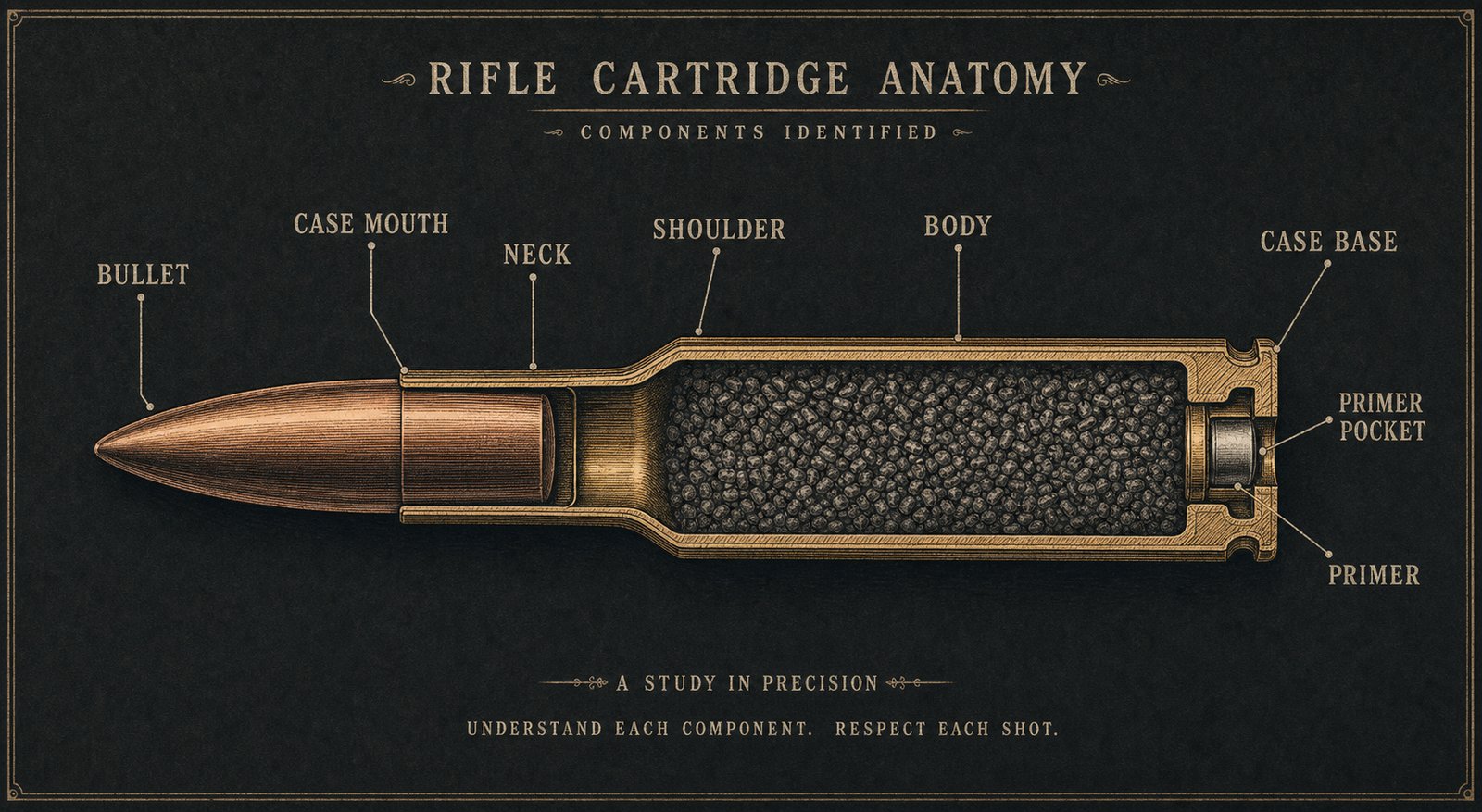
Base (Head). The thick rear face of the case that the bolt locks against. Stamped with the headstamp (manufacturer, caliber). The primer is seated here.
Primer Pocket. Cylindrical recess in the case head that holds the primer. Sized small or large. Loosens after repeated firings at high pressure; loose primer pockets are the most common reason a case gets retired.
Body. The main cylindrical wall of the case. Holds powder, expands to seal the chamber on firing, springs back so the case can be extracted.
Shoulder. The angled section where the body steps down to the neck. The shoulder controls headspace on bottleneck cartridges; bumping it back during sizing is precision work.
Neck. The narrow section that grips the bullet. Holds neck tension; sized separately on most precision dies.
Case Mouth. The open end of the neck. Slightly chamfered after trimming so the bullet seats without shaving copper.
Bullet Ogive. The curved transition from the bullet's bearing surface up to the tip. The first thing that contacts the rifling. Comparators measure to a fixed point on the ogive instead of the variable tip.
Bullet Tip (Meplat). The very front of the bullet. Polymer-tipped, hollow, or open match. Tip diameter varies even within a single box, which is why CBTO is more repeatable than OAL.
Components
Brass. The reusable case body that holds everything else together. Expands to seal the chamber on firing, then springs back so it can be extracted.
Bullet. The projectile that leaves the muzzle. Selected by weight (in grains), diameter (caliber), and construction (FMJ, hollow point, soft point, match-grade open-tip).
Bullet Weight. Mass of the projectile, in grains. 7,000 grains in a pound. Heavier bullets in a given caliber move slower but retain energy further downrange.
Charge Weight. Mass of powder loaded, in grains, to 0.1 grain precision.
Powder. Smokeless propellant. Different powders burn at different rates: fast powders for pistols and small rifle cartridges, slow powders for magnum rifles. Cross-substituting powders is the leading cause of handloading accidents.
Primer. Small explosive cup pressed into the case base. Comes in four sizes (small/large × pistol/rifle), standard or magnum.
Weapon Parts
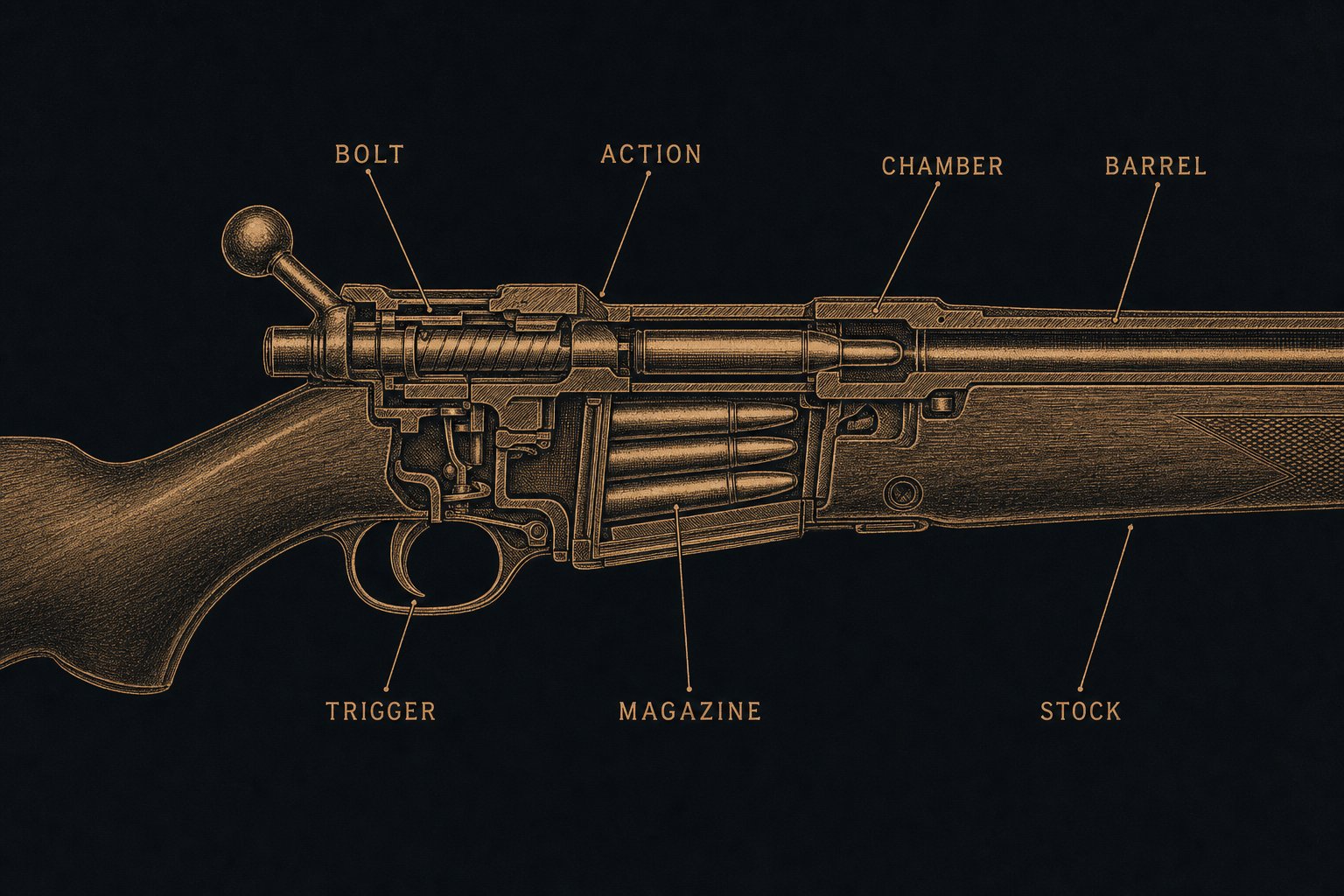
Action. The mechanical assembly that loads, fires, and ejects a cartridge. Bolt, lever, pump, semi-auto, single-shot.
Barrel. The rifled tube the bullet travels down. Length, contour, and twist rate all affect ballistics.
Bolt. The cylindrical part that locks the cartridge in the chamber and contains the firing pin. Bolt-action rifles cycle by hand; semi-autos do it under recoil or gas.
Bore. The hollow inside of the barrel. Bore diameter is the land-to-land measurement and is smaller than groove diameter.
Chamber. The cut at the back of the barrel that holds the cartridge while it fires. Chamber dimensions, headspace, and freebore all live here.
Crown. The very end of the muzzle. A clean, square crown is what holds accuracy; a damaged crown is the most common reason a rifle suddenly loses its group.
Firing Pin. The spring-driven pin that strikes the primer to ignite the round.
Freebore. The unrifled section of the chamber ahead of the case mouth. Long freebore lets you seat heavy bullets out without exceeding magazine length.
Lands and Grooves. The raised ridges (lands) and valleys (grooves) cut into the bore that spin the bullet. Bullet diameter matches groove diameter.
Magazine. The container holding ready cartridges. Detachable box, internal box, tube. Magazine length sets your maximum loaded OAL on most rifles.
Muzzle. The open end of the barrel. Where the bullet exits.
Stock. The frame the action sits in. Wood, polymer, fiberglass, chassis.
Trigger. The lever that releases the firing pin. Pull weight, creep, and overtravel are the three things shooters tune.
Twist Rate. How fast the rifling spins the bullet, expressed as 1 turn per X inches (e.g. 1:8 means one full turn every 8 inches of barrel). Heavier and longer bullets need faster twist rates to stabilize.
Shotgun Shell Parts
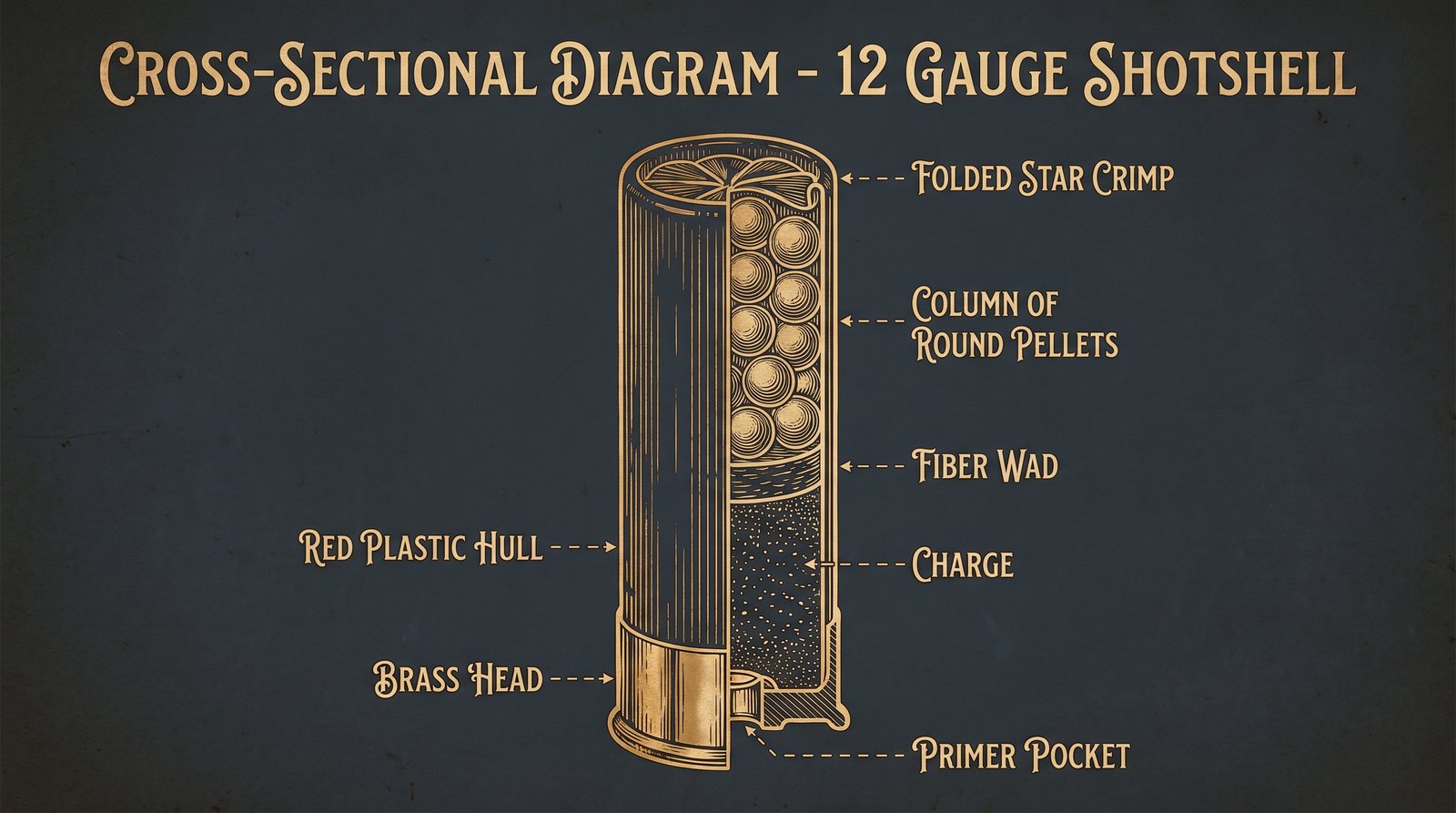
Brass Head. The metal base of the shell, similar to a rifle case head. Holds the primer.
Crimp. The folded or rolled closure at the front of the shell that holds the shot in place. Roll crimp for slugs and buck; star (fold) crimp for birdshot.
Hull. The plastic body of the shell. Reusable for several firings depending on hull design (Cheddite, Federal Gold Medal, Remington STS).
Powder Charge. Smokeless powder, measured in grains (or in some published shotshell data, in equivalent ounces of equivalent dram).
Primer. A 209-size primer in modern shotshells. Replaces small/large rifle and pistol primers.
Shot Column. The payload of pellets (lead, steel, bismuth, tungsten). Measured in ounces.
Wad. The plastic cup that sits between powder and shot. Provides a gas seal, cushions the shot column on ignition, and protects the bore from steel shot.
Measurements
Bullet Weight. Mass of the bullet, in grains. 7,000 grains per pound.
CBTO · Base to Ogive. Distance from the case head to the bullet's ogive (the point where the bullet starts curving toward the tip). More repeatable than OAL because bullet tips vary, even within a single box. Use a comparator tool on your calipers.
Charge Weight. Mass of powder, in grains, to 0.1 grain precision.
Group Size. Distance between the centers of the two furthest shots on a target, in inches or millimeters. The headline accuracy metric for a load.
Headspace. Distance from the bolt face to a defined datum on the case: the dimension that controls how the cartridge sits in the chamber.
Jump to Lands. How far the bullet travels from its seated position before touching the rifling. Some rifles like a long jump (.020"+); some like jam (touching or into the lands). Tuning this is one of the levers in a precision workup.
MIL. Milliradian. Angular measurement: 0.1 mil ≈ 0.36" at 100 yards. Common on European scopes.
MOA. Minute of Angle. Angular measurement: 1 MOA ≈ 1.047" at 100 yards. A "sub-MOA load" prints groups under that.
Neck Tension. How firmly the case neck grips the bullet. With bushing dies, expressed in thousandths of interference (e.g. 0.002 means a bushing 0.002 under loaded neck OD). Consistent neck tension is one of the strongest predictors of low SD.
OAL · Cartridge Overall Length. The total length of the assembled cartridge, measured from the base of the case to the tip of the bullet. Loading manuals publish a max value; staying under it is what keeps the round chambering reliably.
Shoulder Bump. How far the case shoulder is pushed back during sizing, typically 0.001-0.002" for bolt rifles.
Trim Length. The trimmed-back length of the case. Maximum and trim-to dimensions are published in every loading manual.
Twist Rate. Inches per full turn of rifling. A 1:8 twist rotates the bullet once every 8 inches of barrel travel.
Ballistics
Avg. The mean velocity across a string of shots.
BC · Ballistic Coefficient. A bullet's drag-resistance number. Higher BC = less wind drift, less drop. Reported by the bullet manufacturer for each projectile, in either G1 or G7 form depending on the bullet shape.
Density Altitude. The altitude that the current air density would correspond to under the standard atmosphere. Hot, low-pressure, humid air looks like a higher altitude to a bullet. Drives drag, drift, and drop. 60F at 5,000 ft sea level pressure on a humid day reads as roughly 6,500 ft DA.
DOPE · Data On Previous Engagements. The confirmed elevation and wind hold for a specific load at a specific distance, after you've actually fired it. The whole point of a ballistics solver is to give you a starting DOPE; the whole point of a confirmed-DOPE log is to refine it.
ES · Extreme Spread. Difference between the fastest and slowest shot in a string. Sensitive to outliers.
Firing Solution. The combined elevation and windage hold the solver gives you for a specific shot, computed from MV, BC, distance, atmospherics, and wind.
MV · Muzzle Velocity. Speed of the bullet leaving the barrel, in feet per second. The input to ballistic calculators.
SD · Standard Deviation. Statistical measure of how tightly velocities cluster around the average. Single-digit SD over 10+ shots is the precision-shooter target.
Sectional Density. Bullet weight divided by the square of its diameter. A penetration metric; higher SD bullets push deeper.
Spin Drift. Sideways drift caused by bullet rotation, usually right for a right-twist barrel. Material at long range only (typically 600+ yd).
Truing. Adjusting MV (or BC) in the solver until the predicted hold matches a confirmed hold at distance. Faster than re-chronographing in changing conditions.
Wind Drift. Sideways deflection from a crosswind. Proportional to time-of-flight, so high-BC bullets drift less for the same wind speed.
Wind Hold. The horizontal correction needed to compensate for the crosswind. Reported in MOA or mil at a given distance and wind speed. 1.2 mil left at 600 yd in a 10 mph wind from 9 o'clock is one example.
Zero Distance. The range at which your scope is zeroed, in yards. Every drop number is relative to this.
Process Steps
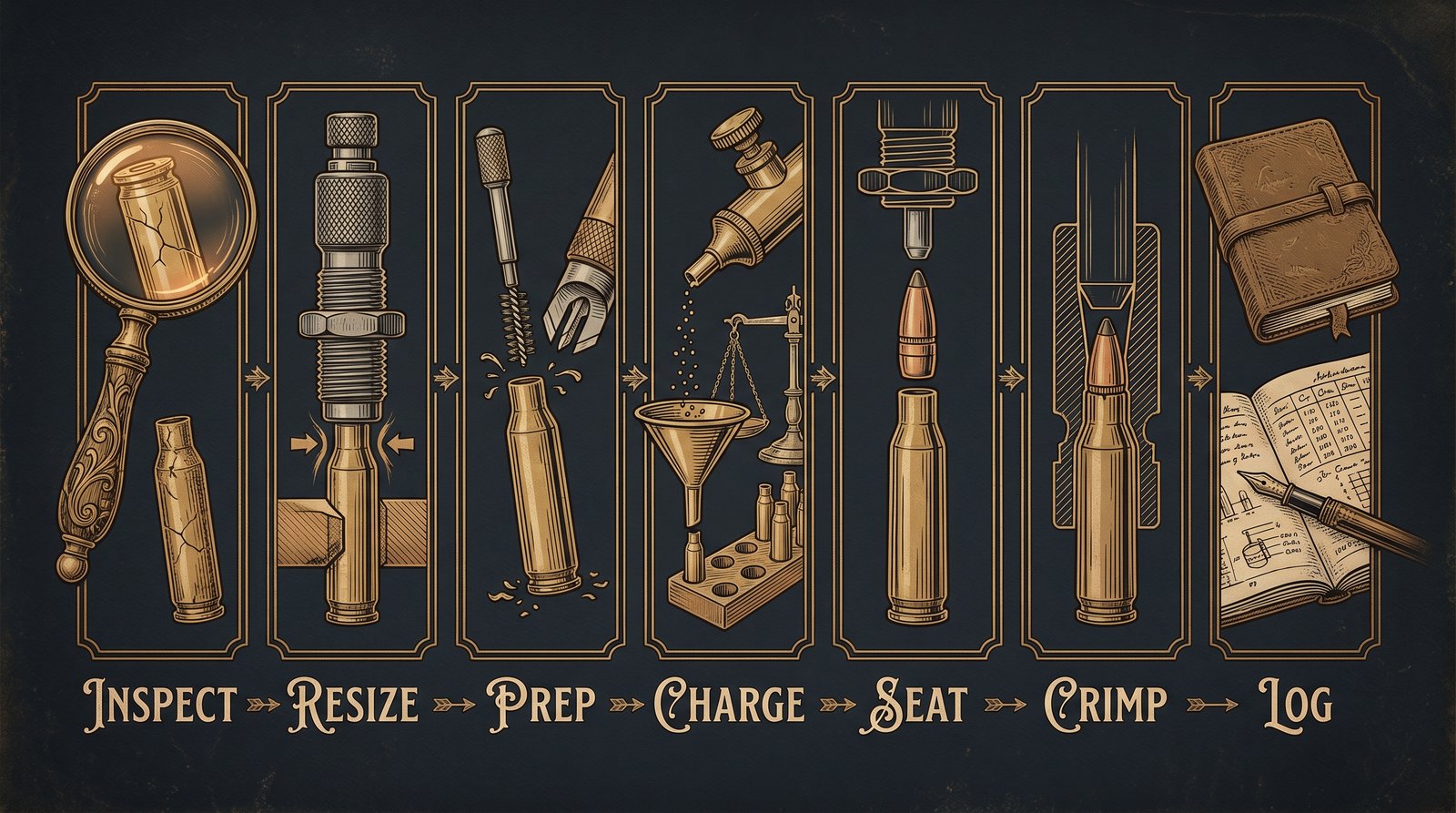
Deprime. Remove the spent primer from a fired case.
Size. Resize the case to a known dimension. Full-length sizes the whole body; neck-only resizes only the neck.
Trim. Cut the case mouth back to a standard length once it's grown past max.
Prime. Seat a fresh primer into the cleaned primer pocket.
Charge. Drop a measured powder charge into the case.
Seat. Press the bullet into the case to a target OAL or CBTO.
Crimp. Optionally crimp the case mouth onto the bullet. Required for some designs (cannelure, semi-auto, magnum), avoided for others (precision rifle).
Log. Record the recipe, conditions, and chrono data. The whole reason BrassTracker exists.
Workup. The process of stepping a powder charge from minimum to safe maximum, usually in 0.3-0.5 grain increments, looking for the charge that prints the smallest groups and lowest SD in your specific rifle.
Ladder Test. A workup variant where you fire one shot per charge weight at the same target and look for two or three rounds that group together at one charge level: a "node".
Pressure Signs. Physical evidence that a load has hit too much pressure: flattened primers, cratered primers, ejector marks on the case head, sticky bolt lift. Stop, drop the charge two steps, and try again.
Brass Life
Annealing. Heat-treating brass case necks to soften them after work-hardening from repeated firings. Roughly doubles neck life when done every 3-5 firings.
Brass Life. Number of firings a case lot has remaining before retirement. Tracked in BrassTracker per lot.
Case Head Separation. Catastrophic failure where the case head shears off behind the extractor groove on firing. Caused by repeated over-sizing. Inspect for the bright stretch ring with a paper clip.
Full-Length Sizing. Resizing the case body all the way down so it'll chamber in any rifle in that caliber. Stretches brass faster than neck-only sizing.
Neck Sizing. Resizing only the neck, leaving the body fire-formed to your chamber. Longer brass life, but only works in the rifle that fired the case.
Shoulder Bump. Pushing the case shoulder back a measured amount (typically 0.001-0.002") during sizing so the round chambers without being over-worked.
Lot Tracking
Brass Lot. Manufacturer batch number on a brass box.
Bullet Lot. Manufacturer batch number on a bullet box.
Powder Lot. The manufacturer's batch number printed on a powder canister. Lot-to-lot variation can shift velocities by 50 fps; record it so you can correlate.
Primer Lot. Manufacturer batch number on a primer brick.