
Bulletz 4 Adultz
A coloring-book primer for grown-ups who want to know how the loud thing works without sixteen tabs of Wikipedia open. In five minutes. Crayons not required, but encouraged.
Heads up. This page is the goofy version. The real numbers, charges, and load data live in your manual and in the rest of the Learn hub. Read this for the vibes. Read those for the bench.
Yo, what even is a bullet?
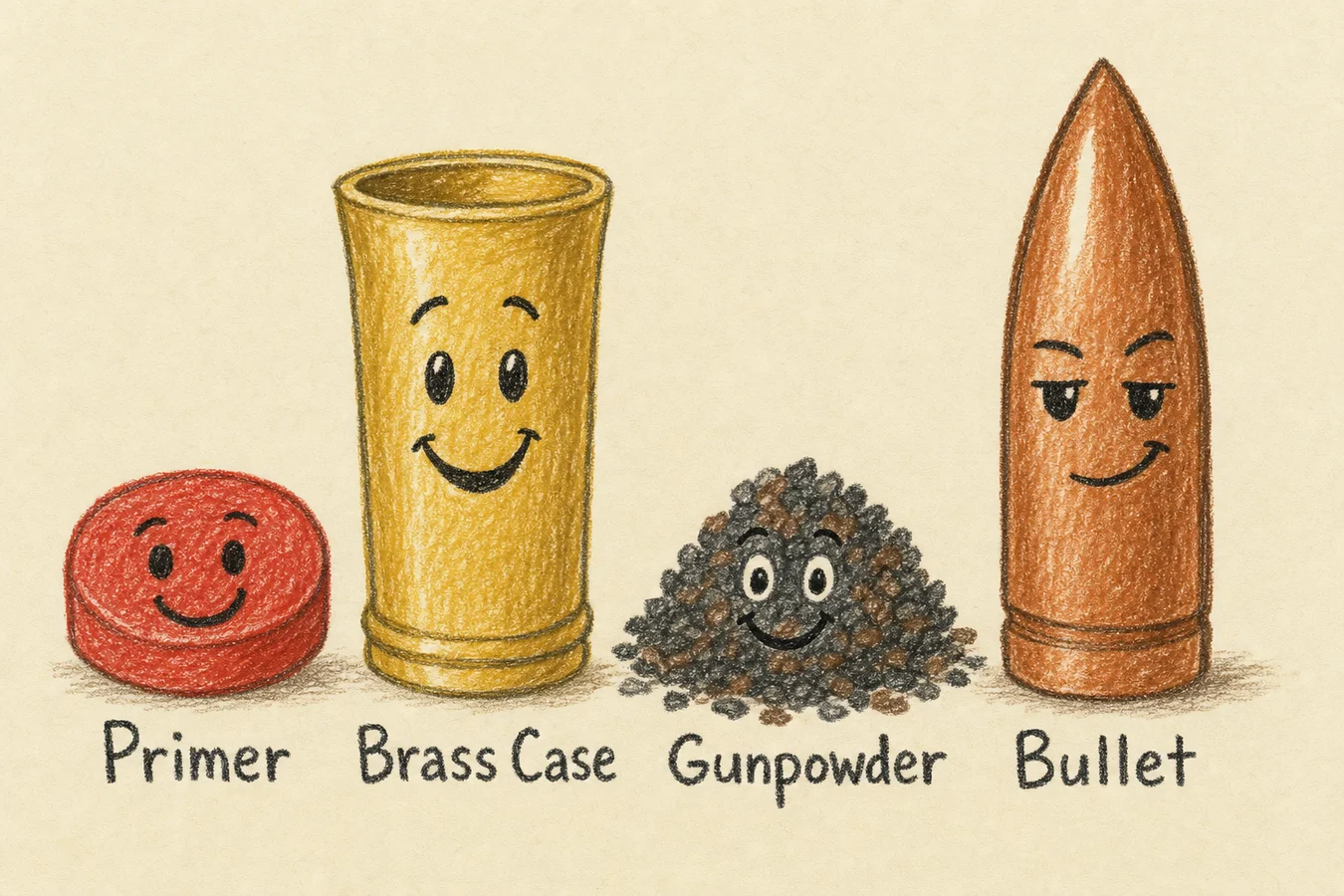
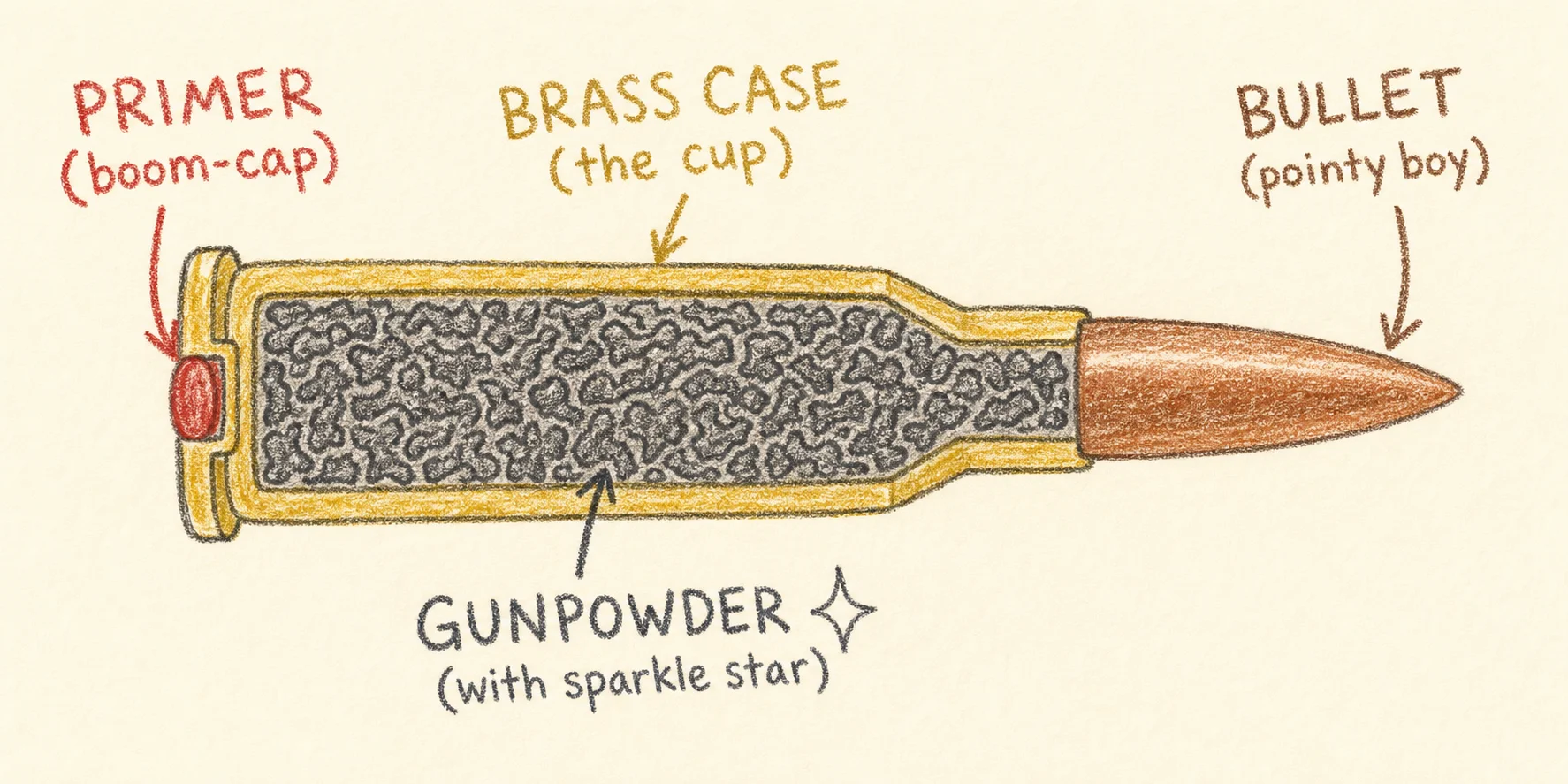
A bullet is the pointy metal nerd that flies out the front. It is one of four parts of a thing called a cartridge, which is the whole little brass package you load into the gun.
The cartridge has four roommates and they all have jobs:
- The bullet is the pointy boy on top. He flies. That's his whole personality.
- The case is the brass cup that holds everybody else. Recyclable. Has trauma after a few uses.
- The powder is yellow flakes inside the case. Looks like fish food. Is not fish food.
- The primer is a tiny chemistry pancake on the bottom. Gets punched. Goes snap. Lights the powder.
People say "bullet" when they mean "cartridge" and that's fine for the parking lot but not at the bench. At the bench you say the right word or someone in a Filson vest will sigh real loud.
How the bullet goes "fwoom"
You squeeze the trigger. A little spring-loaded poker called the firing pin sprints forward and yeets itself into the primer. The primer is a tiny chemistry pancake in a metal cup. It goes snap. That snap shoots a flame through a little hole in the case and lights the gunpowder.
The gunpowder isn't a bomb. It's more like a really opinionated campfire. It burns FAST and barfs out a big puff of hot gas. That gas has nowhere to go because the bullet is plugging the front of the case like a cork. So the pressure piles up, gets mad, and shoves the bullet down the barrel until it pops out the muzzle.
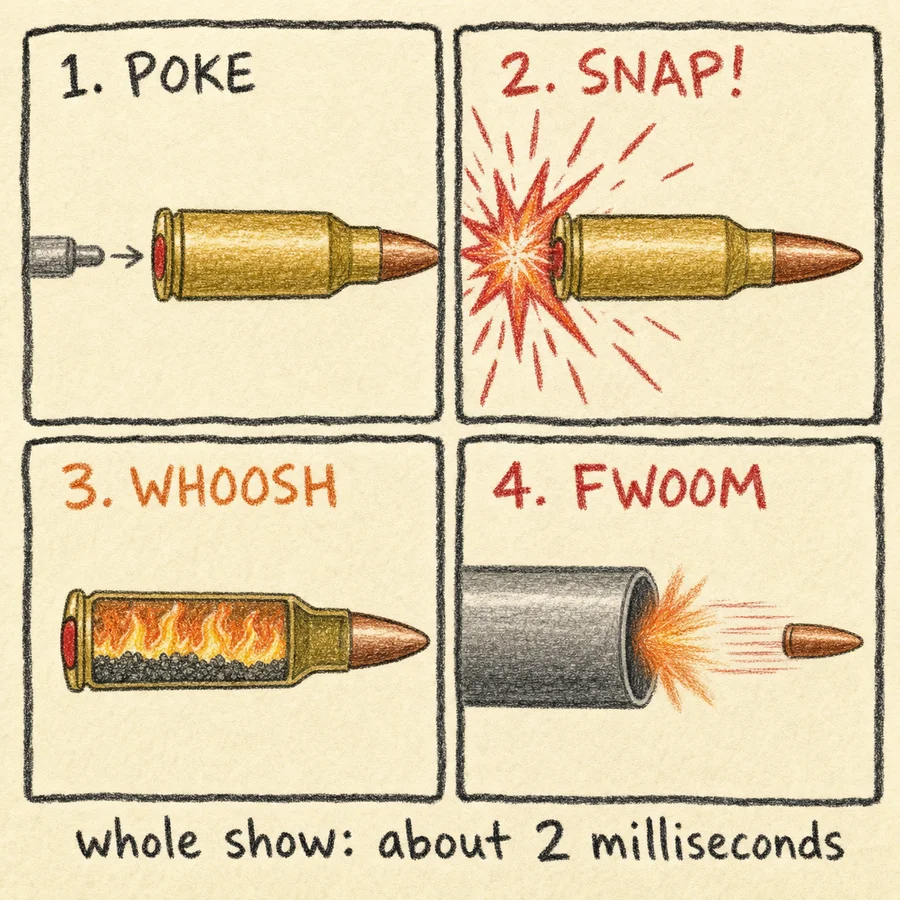
That's it. That is the whole magic trick. The rest is just engineering and shouting at calipers.
Why the bullet doesn't just fly sideways
Inside the barrel there are little spiral grooves cut into the metal. They're called rifling, because someone in 1750 was very pleased with themselves for inventing them. As the bullet gets shoved down the barrel it gets squished into those grooves and starts spinning real fast, like a football thrown by someone who knows what they're doing.
A spinning bullet is a stable bullet. A non-spinning bullet tumbles end-over-end like a wet sock and goes nowhere useful. This is why a smoothbore shotgun can't shoot a slug a thousand yards and a real rifle can.
The spin rate is called twist. "1:8 twist" means one full spin every eight inches of barrel. Heavy long bullets need a faster twist to stabilize. Short stubby bullets are fine with a slow twist. If you mismatch them, the bullet wobbles and your group on paper looks like spilled cereal.
Bullets fall, actually
Yeah. A bullet falls the entire time it's in the air. It does not "rise" out of the barrel. It does not levitate. It does not have main character energy. It falls, the same as a dropped marble, from the second it leaves the muzzle.
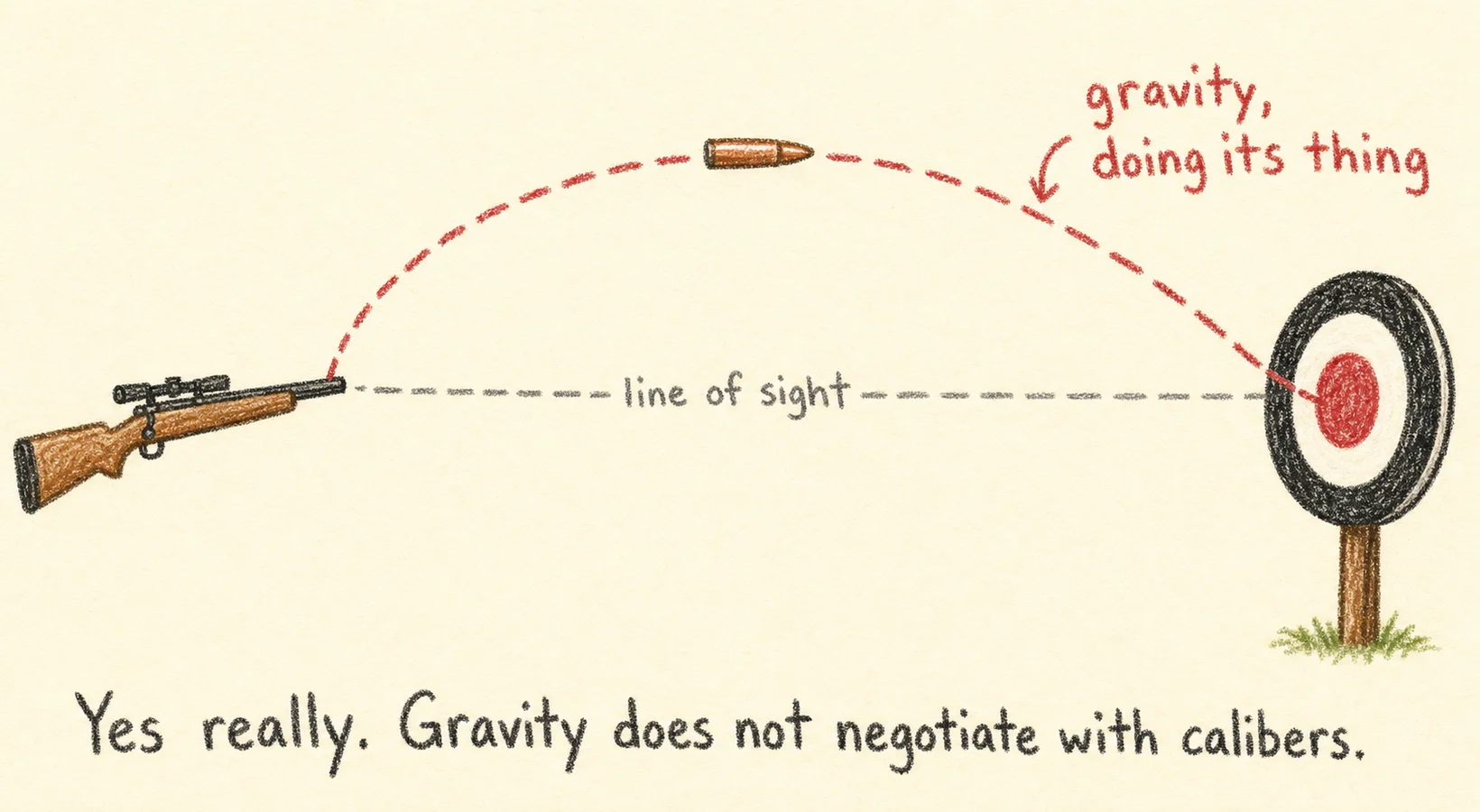
So we tilt the barrel up a tiny bit. Like, fractions of a degree. The bullet's path is a curve that crosses the line of sight twice: once on the way up, and once again on the way down. The far one is your zero. If you zero at 100 yards, the bullet is on target there. At 200 yards it has already started dropping below the line of sight, and at 500 yards it's dropping a LOT.
This is why shooters memorize numbers like "9 mil at 600 yards." That's their DOPE: how much to dial up to hit the target at that distance. Real fancy abbreviation, real boring meaning. It just stands for "the cheat sheet that worked last time we shot here." Yes there's a whole firing solution article for the people who like spreadsheets.
The wind has opinions
A crosswind pushes the bullet sideways the entire time it's in the air. The longer the bullet is in the air, the more it gets pushed. This is why a bullet that flies fast and slips through the air well (high BC, or ballistic coefficient) drifts less in the same wind than a slow chubby bullet trying its best.
You can either:
- Hold off (aim into the wind on purpose).
- Dial windage on the scope.
- Cry.
Most people do all three.
So why do nerds reload their own?
A bunch of reasons. The honest top three:
- It's cheaper per round. Especially for rifle. Especially for cartridges that retail for two dollars a pop. The math always works out if you shoot enough.
- It's more accurate. Factory ammo is built to chamber in every rifle in a caliber. Your handload is built specifically for your rifle's chamber, your barrel's twist, the bullet your rifle likes, and the powder charge that makes your particular barrel sing.
- It's a hobby. Some people do crosswords. Some people brew beer. Reloaders weigh tiny piles of yellow flakes on a thousand-dollar scale and feel powerful.
The one rule, in crayon
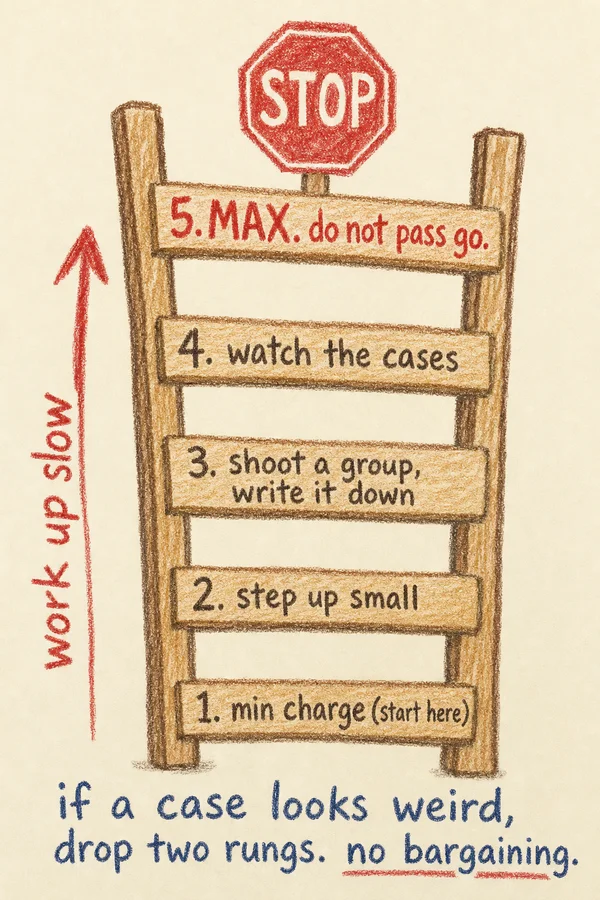
Always start at the published minimum charge in your loading manual. Work up in tiny steps. Never go above the published max. If a case shows pressure signs (flat primers, cratered primers, sticky bolt, ejector marks on the case head), stop, drop two steps, and try again.
That's the entire safety lecture. Print it on a t-shirt and you've got ninety percent of the wisdom your reloading mentor is going to drop on you over twelve beers.
You ready to do the thing?
Read the rest of the Learn hub. It has the actual numbers, the actual processes, the actual chronograph stuff. This page exists so the next time someone says "ogive" at the bench you don't have to fake-nod.
And then write everything down, because if you didn't keep a log of what you loaded, you didn't actually load anything. You just made noise. That's what BrassTracker is for.
⚠️ This page is a vibe primer, not load data. Handloading uses explosive components. Verify every charge against a current published reloading manual before pulling the press handle. Don't be the guy.